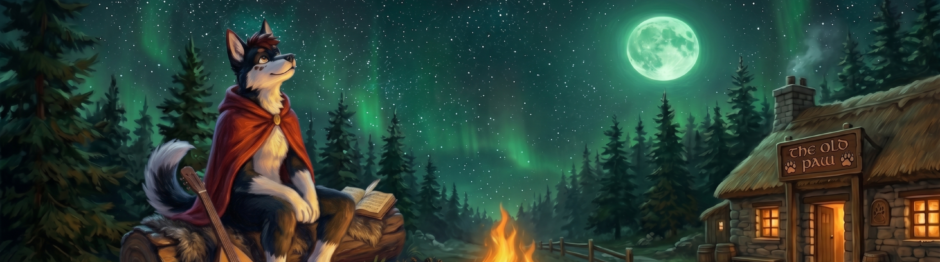
It was late afternoon when a dull, rumbling sound shook the ground beneath Fian’s paws. Moments later, the panicked cries of forest creatures pierced the thicket—a landslide. One of the old slate caves at the edge of the moor—its entrance held together by wet roots and rotting wood—had collapsed under the weight of rain and moisture.
Fian did not hesitate; he immediately made his way to the scene. Sheer chaos reigned. Several forest dwellers—including a distraught mother badger—were running around in a frantic circle. “They’re in there!” someone shouted. “The tunnel is blocked, and the earth keeps sliding down!” Normally, Fian would have waited for the strong wolves or the more practical foxes. But today, he decided he could do something.
Little bard, where is the German version?
Worthy traveler, follow this path, and you will find what you are looking for…
What did he have to lose—his life, perhaps? Whether today, yesterday, or tomorrow—it simply didn’t seem to matter anymore. At that moment, his own life was a matter of complete indifference to him. What was the death of a lowly bard worth, when his days were already numbered anyway? Ignoring the warnings of the onlookers, he tossed his lute onto the damp moss and crawled on all fours into the narrow, damp hole that still stood open. The air was heavy with the scent of crushed earth and peat, while the passage felt terrifyingly tight around him. Yet Fian pushed himself deeper inside; his heart hammered with a force he had never felt before—it was the raw pulse of life itself. A few more meters, and then he found them: young squirrels, frozen with terror, wedged between two heavy stone slabs. With the sheer strength of someone with nothing left to lose, Fian heaved the upper slab upward. “Quick! Crawl out!” he gasped. The young ones obeyed, slipping beneath his arm and fleeing toward the daylight.
Fian was just about to let the stone slabs drop when the earth shifted again, deep above him. A loud, dry crack echoed through the small cavern. Wet mud and rock suddenly slid down. Fian tried to pull back, but he was too slow. A heavy, sharp-edged stone slab pinned his legs beneath it. A burning, searing pain shot through his left leg. He was trapped—caught in the forest’s icy grave. And then, to make matters worse, the rain intensified. At first, there were only scattered, heavy drops slapping dully against the mud above him. But then nature bared its relentless claws: an icy rain set in, and water gathered rapidly in the collapsed cavern, causing the earthen pit where Fian was trapped to fill visibly.
The water rose fast; it was icy, muddy, and reeked of the decay and death of the moors.
Fian tried desperately to heave the heavy stone off his legs. He clawed and struck at the stone with his paws until his own claws splintered and bled, but it was in vain: the stone defied every conceivable effort. The water reached his belly. Then his chest. He tried to cry out for help, but the stench of decay and death constricted his throat. His voice—which usually rang out clear and bright in the tavern—was reduced in that watery grave to a pitiful, stifled shadow of itself. The ice-cold mud crept up to his neck. He had to tilt his head back to keep his nose above the water; his limbs grew numb with cold as the struggle against the crushing weight of drowning neared its end. He was helpless, powerless… and then he paused. So this is how it ends, he thought. Not on a grand, tragic stage beneath the full moon, immortalized in the songs of future bards. But silently, wet, and unnoticed in the mud of a nameless cave. So be it… He closed his eyes and let his breath escape. The water rose above his mouth. Darkness enveloped him…
Suddenly, the darkness exploded.
A violent tearing sound, the grinding of stone against stone, and the brutal splash of churned-up water snapped him out of his stupor—and in the final, fading moment of consciousness, he saw them: amidst the black, muddy torrents appeared two glowing, ice-cold stars of purest glass—eyes that beheld him with unfathomable ferocity. Two powerful paws gripped him by the scruff of the neck. And a raw, merciless force hauled him from the mud. The stone that had held his legs captive was flung aside with a loud, splintering crash. Someone had dragged him from the depths of the cave out into the pouring rain of the late afternoon. Fian collapsed into the mud, coughing, gasping, and spewing muddy water from his lungs. His fur was soaked through; his paws, with their splintered and bloody claws, were caked in mud. He simply sat there, utterly exhausted, unable to move. He looked up and froze:
There she stood—that one white lady wolf.
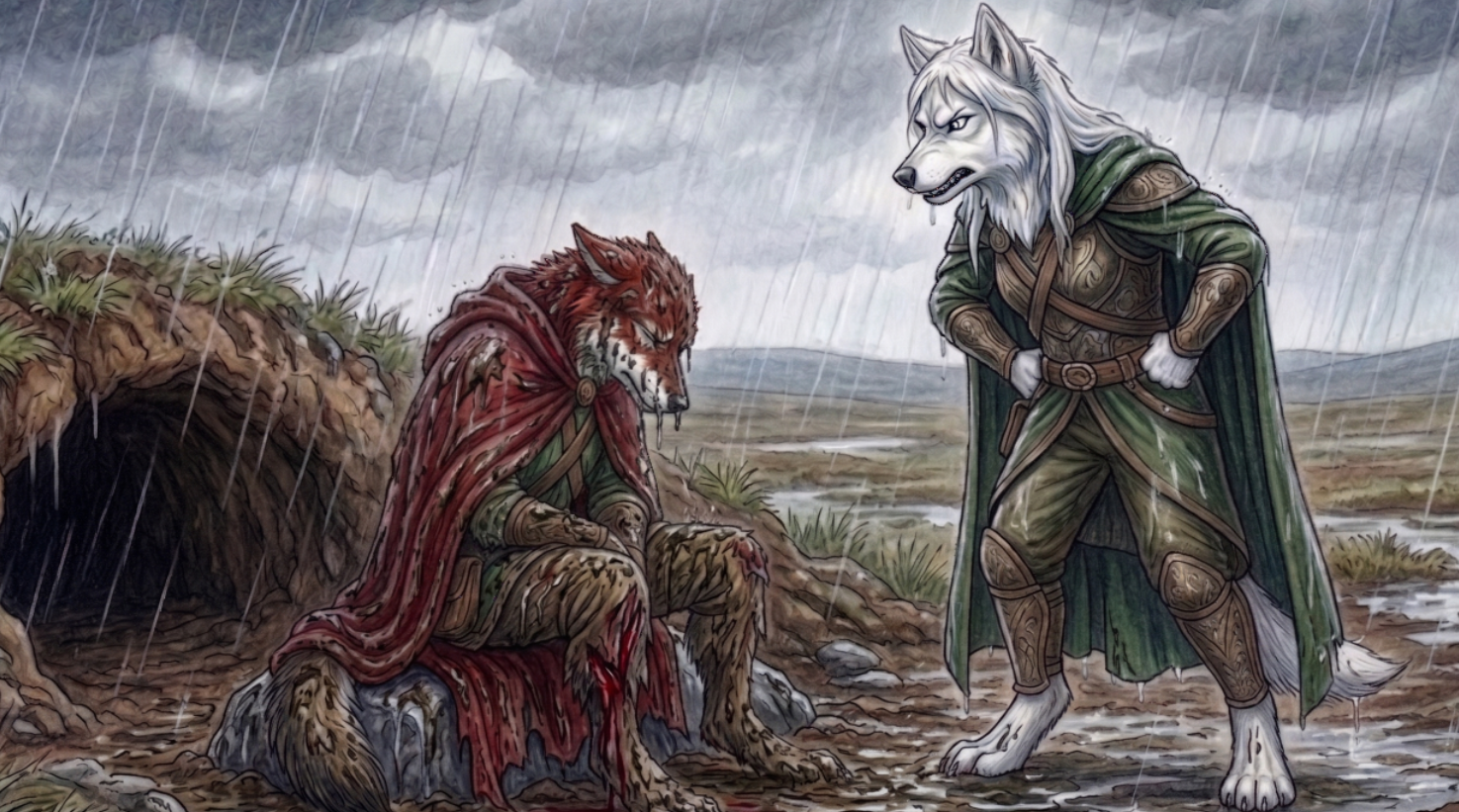
Her coat, usually so immaculately white, was smeared with mud and blood. She was breathing heavily; her chest heaved in a wild, uncontrolled rhythm. And then, something happened that Fian would never have thought possible in all the weeks they had been meeting. She took a step forward, raised a heavy paw, and delivered a massive, resounding slap. The blow struck with full force, yet it was not a lethal claw tearing at his flesh. It was pure rage, and it hit so hard that Fian landed in the mud of the clearing. As he struggled to his feet, clutching his burning cheek, he looked at her—and held his breath. There was no aloof coldness in those blue eyes. Her ears were flattened against her head; her ice-blue eyes did not reflect a predator sizing up its prey—instead, he found himself looking into eyes that gazed at him reproachfully. Fian was bewildered. The pain, the cold, and the pent-up anger of the past few weeks erupted from him. “Why?!” he shouted at her, his voice raspy and hoarse. “Why are you doing this? Why… do you, damn it?!” She stood motionless in the rain, water streaming down her face, yet she did not look away from him. “What is this all about?” Fian shouted, tears of rage mingling with the rain on his face. “My time is running out anyway! You’ve told me that often enough! And you’ve been lurking around me for weeks, watching my every move. You’re just waiting for the full moon so you can finish your ritual game! So why won’t you just let me choose my own fate in this cave?!”
The lady wolf closed her eyes for a moment, and when she opened them again, that icy blue coldness had returned. “Precisely… because,” she whispered, her voice so quiet it was almost drowned out by the sound of the rain. “What?! ‘Precisely because’?! That’s all you have to say?!” Fian raged, struggling to find a foothold in the muddy ground. “Do you have any idea how awful this is for me? You’re constantly lurking nearby. You act as if I’m your property, or your little trained pet for the tavern! And there I am, driven to despair! What is the point? Are you guarding your prey like a slab of meat just so you don’t lose face in front of your pack and the Eternals for letting me go the first time?”
The lady wolf took a sudden, swift step toward him. She leaned down so close that he could feel her hot breath on his face. She tapped him sharply on the forehead. “Open your eyes, you blind fool!” Her voice trembled with rage. “Just look at what’s actually there, for once! Look at me! And for God’s sake, stop constantly cobbling together new, meaningless theories with that bard’s brain of yours to explain things you haven’t actually experienced. How could your little head possibly know what is true when your thoughts are forever painting new explanations and images for you? You want to take this path? Then take it! You’d rather take that one? Then take that one! You don’t know which of the many paths is the right one? Then choose the path of asking! But the fact remains: there is no right or wrong path here! There never was, and that is simply the bitter truth behind all your colorful stories and ideas about why things are the way they are!” Then she turned and simply walked away. Slowly and with great dignity. He stared after her, speechless. Yet her words slowly echoed through the fog of his thoughts.
Could it be—was her constant, seemingly menacing presence perhaps not a ritual of the hunt after all? A few meters away, she sat down without a word on a wet, gray stone in the rain. She no longer looked at him. She simply stared silently out into the gray, swirling moor, while the rain fell ceaselessly, making a soft, clicking sound against the forest moss.
Fian didn’t know how long he sat there in the mud, but the cold crept deeper and deeper into his bones as the paralyzing anger in his chest slowly faded. What remained was a gaping, icy emptiness. He looked over at the white figure sitting on the stone, who didn’t deign to glance his way. Eventually, he gathered the courage to stand up. Every step hurt; his left leg was bleeding. He dragged himself slowly across the wet grass until he stood beside the stone where she sat. Carefully, almost shyly, he sat down beside her on the cold, damp moss next to the stone. She did not stir—did not even prick up her ears—simply letting him sit lost at her side in the gray twilight of the late afternoon.
After what felt like an eternity—with the rain slowly washing the mud from her white fur—she turned her head toward him. Her ice-blue eyes pierced the pale twilight. “Have you composed yourself?” she asked softly.
Fian looked down at his trembling paws. Somehow, he had no clever words, no songs or theories about the moon’s shifting paths, or anything of the sort one might say. “No,” he answered very quietly, his voice nearly failing him. “I can’t go on. I simply don’t know what to do.” After seconds that seemed endless, filled only by the sound of the rain, the queen of the cold gently lowered her head. She gazed at him for a long time, with a look that cut deeper into his soul than any blade ever could. “And then?” she asked softly. Fian closed his eyes and drew in the cold air. “Not a single path I can see for myself leads anywhere,” he replied, carefully placing his paw near hers. She noticed his paw but simply kept looking at him. “…and?” she asked. He lowered his ears as he spoke: “I… I can’t do this alone… And I’m just scared.” He looked at her, seeking help. Finally, she gently placed her paw upon his and answered thoughtfully: “Well, look at that, my little bard has made a decision and is willing to take responsibility for his words?” He first lowered his head, then nodded silently. In a trembling voice, he said: “I lay my life in your paws. I will follow the path you show me, wherever it may lead.”
With her other paw, she gently took hold of his jaw and lifted his head; her ice-blue eyes burned into the depths of his soul as she spoke: “My little bard, you are not alone. I stand by your side and will guide you along this path, wherever it may end for you. For now, simply clear your mind and listen to the rain. It sounds so soothing and beautiful. Then sleep for a while. And when the day breaks, I shall speak, and you shall learn.”
Then her gaze turned abruptly stern as a claw shot out from her gentle paw and sliced into his: “But woe betide you if you ever undertake such a risk as this without my leave …”
Pingback: The Path of the Soul | Fian The Bard