 Worthy travelers, the Mistwood Forest is not only claw and fang. Within the silence in between, there are so many things to be seen:
The date is October 10, 2026:
When the thick autumn mist swallows the paths of Mistwood and the nights grow noticeably longer and more unforgiving, the gaze of the solitary turns instinctively upward. In the night sky, the Eternals – silent witnesses to our rites and oaths—trace their flaming judgments. From the turning point of autumn to the depths of winter, the firmament holds spectacular events in store.
Here is a calendar guide to the celestial highlights of 2026, woven from the poetry of the forest and practical knowledge for your night watches:
October 21–22: The Hunter’s Tears (Orionid Meteor Shower)
As swift shooting stars race across the celestial canopy, they appear like the fleeting tears of the Eternals shed over the folly of mortals. These cosmic sparks originate from the tail of the famous Halley’s Comet.
The real takeaway: The catch in 2026 is the Moon itself – on that evening, it is about 80% illuminated, and its brilliance outshines the fainter trails. Consequently, the best viewing window opens only in the early morning hours after the Moon has set, when darkness becomes absolute for a brief time.
Around November 14: The Silent Council of the Eternals (Grand Planetary Parade)
In the damp hours of early morning, just before the glow of the sun touches the horizon, a rare gathering assembles in the firmament. Mercury, Venus, Mars, and Jupiter align in the southeast, as if cosmic powers were holding a silent council.
The real takeaway: For early risers and astrophotographers, this is the absolute highlight of November. Turn your gaze southeast before sunrise—the four planets appear so close and bright that they look almost like beads on a glittering string. A spectacular sight set against the purplish hues of the dawn sky.
November 17–18: Sparks from the Lion’s Claw (Leonid Meteor Shower)
The Leonids bring extremely fast, bright meteors with long, glowing trails that look like claw marks etched into the deep black of the sky.
The real takeaway: Expect around 15 meteors per hour. However, keep your eyes peeled: The Leonids are famous for sudden, unexpected outbursts of activity, during which the sky can seem to burst into flames for a few minutes.
November 25: The Eye of the Icy Seer (Uranus in Opposition)
On this day, the distant, ice-blue shimmering planet Uranus stands directly opposite the Sun and reaches peak brightness. Like the uncorrupted, glassy eye of the White Guardian, it gazes down upon our little Earth.
The real-world bonus: Uranus is visible all night long and closer to Earth than at any other time. Under an extremely dark sky, far from urban light sources, you might just be able to make it out with excellent eyesight. With binoculars or a small telescope, it reveals itself unmistakably as a tiny yet beautiful blue-green disk.
December 13–14: The Flight of the Sky Knights (Geminid Meteor Shower)
The undisputed shooting star highlight of the entire year! The Geminids are considered the most prolific and reliable shower of all. On this night, the bats—the loyal knights of the Moon Goddess—fly through a veritable rain of stardust.
The real-world bonus: Conditions in 2026 are simply fantastic!
The crescent moon is only 21% illuminated and sets below the horizon early in the evening. Perfect, undisturbed darkness awaits, allowing you to count up to 150 shooting stars per hour. The radiant point lies in the constellation Gemini, but the trails streak across the entire firmament.
December 21: The Consecration of the Infinite Night (Winter Solstice)
The shortest day and longest night of the year mark the astronomical beginning of winter. In Mistwood, this is the hour when the power of the Moon Goddess reaches its absolute zenith. Darkness reigns supreme, and the existential cold makes its ritual demands.
December 24: The largest moon of the year meets human Christmas Eve
This year, the Mistwood Forest and the human world experience a rare convergence. While the inhabitants deep within the misty forest prepare for the arrival of the moon in her perfect, silvery splendor, humans beyond the borders illuminate their villages and towns with thousands of lights to celebrate their traditional Christmas. Yet on this night of luminous contrasts, the Moon weaves her ancient magic: over the mist-shrouded moors, she creates a shimmering portal of pure moonlight. For this one special night, she grants selected human bards safe passage into the misty forests, allowing their earthly melodies to blend with the unwritten songs of the woods.
29 December 2026 to 2 January 2027 – The Moon Goddess Portal
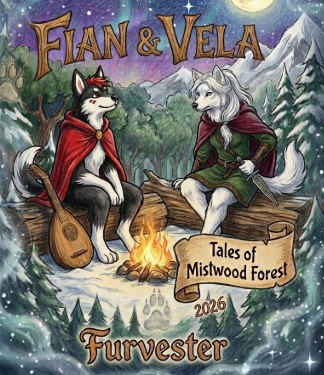 This year, the moon goddess wove a silvery portal from the mistwood forest to … the Townhall of Karlsruhe, which allows Fian for the very first time to visit the legendary hall of man.
If you look around, maybe you will find a Bard that is sitting somewhere with a lute and do what a Fian will do:
Playing tunes and having fun talking to other visitors. … He will visit the legendary furvester.
And yes: HAPPY NEW YEAR FROM FIAN AND VELA.