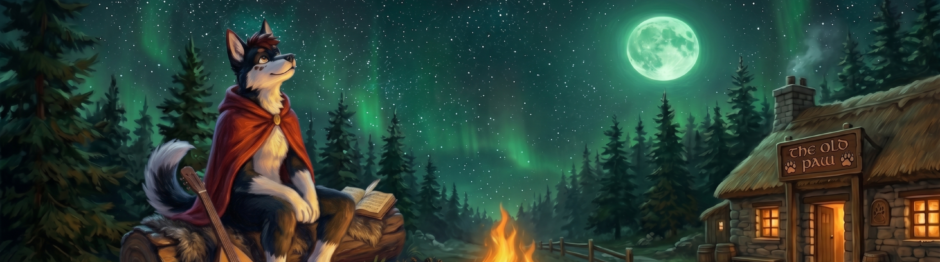
 Worthy travelers, you have surely wondered when I would finally tell you something about the wolves. Well then, I think your curiosity deserves to be rewarded a little.
The wolves dwell at the foot of—and high within—the mountains beyond the Mist Forests. This is their land. Anyone wandering those ancient paths should do so with respect and be mindful—especially of their words. Wolves sometimes take spoken words astonishingly literally, and an unwise remark can practically force a wolf to act. Indeed, wolves operate differently than foxes. Over the years, this has repeatedly led to… well, let us call them misunderstandings. Both observe the same world, yet often draw very different conclusions from it.
My worthy bard, maybe this lore text is avaiable in German ?…
Indeed my beloved visitor. Follow this not so hidden path 🙂
The foxes of the moors are pragmatists. They view their environment as part of a vast system that must function. Anything that serves a purpose holds value, simply because it fulfills the role for which it was created. Order, utility, and function form the foundation of their thinking. Wolves, on the other hand, do not focus on what a life currently achieves; they look at life itself. They do not ask primarily what a being is, but rather what it might yet become. To them, a life possesses value long before it has the chance to prove that worth.
And that is precisely where the age-old conflict between moor and mountain begins. So, take a cup of tea—or perhaps some mead—sit by the fire, and lend an ear to my words.
For to understand the wolves, one must first grasp that they often judge not what stands before them, but what might one day emerge from it.
On Life, Guilt, and Responsibility in the Mistwood Forest
To comprehend the mindset of the wolves, one must understand that in the Mist Forest, the sun, moon, stars, and the Eternals are not mere symbols, myths, or parables. They are real powers whose gaze rests upon the world, and yes, they do occasionally take the time to speak—not of decisions, but of things that might be possible and paths that could be taken.
Before them, every life is weighed and every action remembered. No being wanders the forests unobserved. Thus, the wolves—viewing themselves as the highest representatives among these eternal powers—regard themselves as guardians of the sacred order. Consequently, life and death are not to be seen as personal matters, but as decisions of cosmic significance. Whoever acts binds themselves to the consequences of their actions. Whoever judges is judged in turn. Whoever grants protection assumes responsibility. This is the foundation of the Law of the Wolf.
The Yoke of Guardianship
And no, the wolves do not view themselves as rulers over other lives. To grant a soul guardianship is not to lay claim to ownership; rather, one becomes a guarantor for that life. One declares before the Eternals a willingness to bear responsibility for another being’s fate. From that moment on, a bond is forged between mentor and learner. The mentor’s duty is not to compel obedience; instead, their task is to instill in the learner an understanding of life’s priceless value and to guide them onto a path of truth. Should the learner fail, recklessly cast away their own life, or stubbornly shut themselves off from reality, that failure does not go without consequence. The mentor must answer to the Eternals as to whether they have lived up to their responsibility.
Thus, sternness and wrath stem not from a lust for power, but from the fear of failing to fulfill a duty one has undertaken.
The Learner’s Responsibility
The learner, too, bears responsibility… To step under a wolf’s protection is not to be stripped of one’s freedom. Instead, he is given the opportunity to recognize the value of his life anew—or, in some cases, for the very first time. The greatest enemy on this path is indifference. Some take refuge in fatalism or inventive excuses, or embrace the notion that their fate was sealed long ago. According to the understanding of the wolves, this constitutes an unimaginable rejection of life itself; for as long as a heart beats, there is a duty to act consciously. The learner is therefore guided and urged not to flee from his responsibility, but to face it openly.
The Nature of Karmic Guilt
Every death leaves a mark. According to the Law of the Wolves, the violent ending of any life creates a wound in the fabric of the world. This wound cannot be erased, undone, or forgotten. Whoever claims the flesh of another being simultaneously commits to becoming the guardian of that wound. The guilt does not vanish; it merely acquires a name. The wolf assumes lifelong responsibility…
…to bear this burden before the Eternal. Therefore, killing is never done lightly, never trivially, and never without grief.
The Law of Fire
For the wolves, the hearth fire is a place of truth. Whoever enters the circle of the fire steps out of the roles and masks of everyday life. Origins, rank, pride, and fear lose their significance there. Before the fire, only the truth matters. Here, disputes can be settled, judgments pronounced, or protection granted. Within its light, a sacred peace prevails for a time; violating it is considered a grave desecration. The fire reminds all present that every life is beheld by the same heavens.
The Law of Listening
Truth demands attention. Wolf culture therefore teaches that there are moments when speaking must take a back seat—not out of submission, but out of respect for the act of learning. When a mentor speaks, the learner is expected first to listen, observe, and reflect. Only those willing to set aside their own preconceptions for a moment can receive new insight. The wolves poetically describe this state as “The river rests,” “The wind holds its breath,” or the like. Crucially, this does not mean remaining silent out of fear; rather, this form of expression signifies a silence born of the readiness to understand.
The Five Most Important Sacred Rites
Wolves do not tend to record their sacred rites in scriptures, legal scrolls, or codes. Instead, they preserve them in the songs, stories, and legends of the Mist Forest. Anyone wishing to understand the Law of Claw and Fang or explore the customs of the wolf packs should therefore look less to books and more to the ancient songs. Much within them is deliberately cryptic, ambiguous, and rich in imagery.
A wanderer might hear a romantic declaration of love in a song, while a wolf recognizes within it the proclamation of a legally binding verdict. The truth often lies between the lines, hidden in symbols, gestures, and allusions.
Wolf folklore serves purposes beyond mere entertainment. It preserves the memory of Wolf Law and the decisions once made under the gaze of the Moon, the stars, and the Eternals. Yet, one must bear in mind that these rites rarely occur in isolation.
They may complement one another, follow in sequence, or even act in opposition. Often, multiple rites overlap within a single encounter, revealing their true meaning only through their interplay. The wolf holds the authority to decide which rite to follow at any given moment. Thus, the true power of wolf jurisprudence lies not in individual rules or actions, but in the resonance between the rites; for it is only where they converge that judgment, responsibility, guardianship, and guilt arise.
The Rite of Silent Binding
A hunter claims the flesh of honorable prey that has submitted to the judgment of claw and fang. At the same time, he pledges to bear the resulting debt and become a guardian of the cosmic wound.
The Law of the Singular Verdict
Once a being is officially placed under protection, any future claim to that prey by the same hunter is voided. The verdict is final and may not be revoked.
The Law of Exclusive Access
The gesture of the paw or claw belongs solely to the designated guardian. It is a sign of protection, responsibility, and care. No other hunter may assert this claim.
The River Stills
The apprentice sets aside his own judgment for a moment in order to hear, understand, and learn. Knowledge arises from attentiveness, not from volume.
The Law of the Fire
Within the circle of fire, truthfulness and peace prevail. There, all beings meet without masks and without rank, under the gaze of the Eternal Ones.
The Divide Between Wolf and Fox
The deepest difference between wolves and foxes lies not in their customs, but in their understanding of life. For foxes, the value of a being is measured primarily by its function within the community. Utility, order, and practicality lie at the heart of their thinking. Wolves, on the other hand, regard every life as a sacred gift of creation. Its value depends neither on origin nor on achievement, rank, or utility.
- Where foxes ask, “What purpose does this life serve?”
- wolves ask, “How could a life be without value?”
From this fundamental difference arise many of the oldest conflicts of the Mist Forest. For to the wolves, every soul is part of the cosmic whole, and every decision regarding life or death is simultaneously a decision as to who will bear the responsibility before the Eternal Ones.
Pingback: The Path of the Chronicler | Fian The Bard