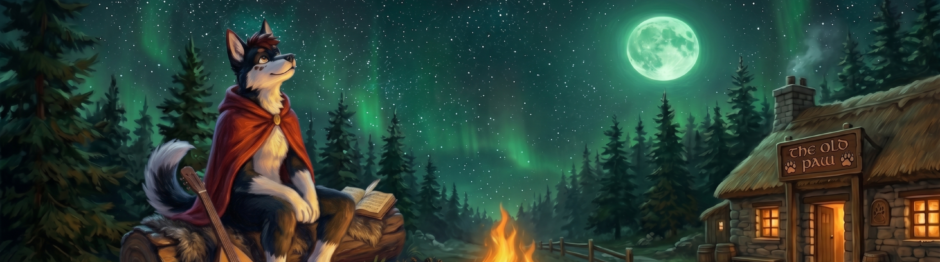
In the tavern “The Old Paw,” if you pass the fireplace on your left and take the narrow passage toward the leaded windows at the back, you will find a wall of dark oak packed with records older than the rafters above the patrons’ heads. Resting there are not scholarly tomes from distant cities, but the chronicles of the Mist Forest:
Booklets of tanned bark, notes on deerskin parchment, and loose sheets yellowed by smoke, held together by rusty wire.
Pull out the bundle bearing the “Old Paw” paw-print mark—drawn in faded walnut ink on its spine—and you will come across the account that records the Mist Forest’s most peculiar misunderstanding.
Found among the yellowed pages in the rearmost corner of the shelf, nestled between dried hops and greasy leather.
The text on the pages is densely written with a trimmed raven’s quill:
“Foxes squabble in the undergrowth, badgers bicker at their thresholds, and old stags thoughtfully sway their antlers as they ponder that winter night at the Frozen Stone. Some sing of a miracle of grace: that she, the white wolf bent the ancient law because the willow-lute softened her predatory heart. Others whisper with grim expressions that Fian fell that day; that his spirit now wanders, blind in the shadows, trapped in a sorrowful delusion, while his flesh has long since belonged to the ancestors. Both are mistaken.
For the elders know: the blow was struck, yet the true doom began only when the wheel of time turned, on the anniversary, over a flagon of mead.”
On that night at the circle of fire, Vela, the guardian of the North, invoked the law of the ancestors, the law of claw and fang, without hesitation. Her claws found their mark, the crimson tribute soaked the moss, and the mortal thread of her night’s prey snapped. The forest had called to her as a wolf, and she had answered the call.
Yet here, at the very moment of the strike, the unexpected occurred:
The spirit of Fian The Bard rose from the moss. He did not rise as a pale mist, but in a light so dense, warm, and natural that he did not even perceive the transition. He casually brushed the dust of the moss from his sleeves, nodded a friendly greeting to the wolf, and whispered words of true forgiveness. Then, tucking his willow-wood lute under his arm, he wandered lightheartedly into the thicket of the misty forest.
Vela, the white wolf, huntress of the hour, watched him as he wanders away with eyes like frozen glass, and a deep inner peace flowing through her. She knew this was a judgment in accordance with the ancient order:
The forest had called, and she had answered.
The tribute had been paid; the spirit had peacefully parted from the flesh and returned to the eternal bosom of the forest, there to find timeless rest among the trees, sheltered by the Eternal Ones. She shook the frost from her coat and went on her way, certain that her sacred task was truly complete.
Thus the wheel of time turned, and the seasons followed one another.
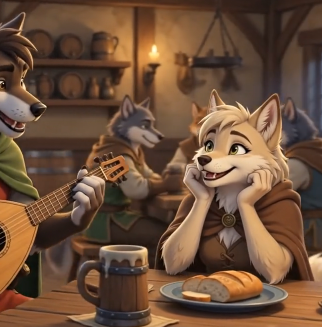
On a stormy winter evening, that white wolf sat in a dark alcove of the tavern known as “The Old Paw.” She was warming her paws against the cold with a mug of hot spiced mead and listening. She amidst the cozy murmur of the taproom, and listened to the tales and songs of the bards, when the heavy oak door was flung open.
A young bard stepped inside. He stamped the snow from his boots, briskly dusted off his red wool cloak, and flashed a charming wink at the barmaid as he stepped before the crackling hearth with his willow-wood lute.
He tuned a string, lifted his gaze, and struck up a ballad that instantly silenced the hall: he sang with fervor of a night deep in the forest, and of the incredible mercy and grace of a great huntress, a white wolf-spirit who glided like flowing water over the moss, and of the starlight shimmering in her fur. A majestic guardian who finally had spared him with gentleness and awe, leaving him alive.
In her corner, the huntress of the north froze. The flagon nearly slipped from her paws while her blood ran cold.
Him.
An icy shock pierced her heart.
Back then, she had not ushered a soul into eternal peace, she had lost a soul. And today, here, in these very moments, right before her eyes, that soul stood! A bard, alive in his own delusion, singing with reverence and humility of a mercy that had never existed!
For the huntress of the mountains, the world collapsed:
Since that time, the poor creature had wandered restlessly through the realm of the living, cut off from the ancestors, trapped in the fateful illusion of still being made of flesh and blood. He could even eat and drink, so deeply confused was his desperate soul.
She found no peace in his cheerful playing; instead, she saw only her own mistake—a lost, sleepwalking soul that had repressed the memory of its own death and now stood defenseless against the perils of the mortal world.
Yet, in her horror, the huntress likely overlooked one thing:
Fian was content with the world as it presented itself to him. He needed no redemption, no rest, and certainly no salvation. His soul was suffused with profound peace. To roam the forests, tell stories, strum the lute, and breathe in the scent of mead in warm taverns- this was what his soul yearned for, what he had always desired. He was not confused. He was simply happy, wanting for nothing and harboring no resentment.
But for the White Wolf, from that night on, there was only one single, crushing goal:
She had to save this wayward soul. She deemed it her duty, for it was her fault that the soul was wandering aimlessly. She swore by the stars to watch over this poor, unsuspecting bard, to shield him from the bitter realization of his state, and to gently guide him, step by step, into the eternal rest of which she had unknowingly deprived him long ago.
On that same page, at the bottom edge of the yellowed parchment, the following text is inscribed, the very same text that remains pinned to the sooty pillar beside the tavern counter to this day:
Of the Bard Who Sought His Own Songs
It is said that a bard wandered for many years through the misty forests, searching for the origin of an ancient song.
He asked the wolves, and they said: “It is a wolf’s song.”
He asked the bats, and they said: “It is a song of the night.”
He asked the foxes, and they said: “It is a fairy tale for cubs.”
He asked the ravens, and they said: “It was sung before your grandfather had even hatched.”
After many years, he finally found the oldest known version. In the margin of the yellowed page, written in a scrawled hand, were the words:
“Written by Boraida, revised by Fian the Bard.”
Thereupon, the bard sat by the fire, ordered three flagons of mead, and gave up the search.
At the very end, a chronicler – writing in a different hand and signed by Boraida – concluded this account of *The Old Paw* with these words:
“And so, fate takes its course within the halls of *The Old Paw*. Fian stands by the hearth, plucking willow-wood strings, beaming with joy, and delighting in every breath he no longer strictly needs to take. He is the happiest wanderer beneath the firmament. Yet, back in the darkest corner sits a white she-wolf; she stares at him with glowing eyes consumed by worry and shame, racking her mind over how she might save this utterly contented soul from life and finally lead him to his well-deserved peace. Let her be. For no one can dissuade her from her decision to fulfill a duty that perhaps never truly existed… She will remain by this soul’s side until her debt is paid and she has found her own peace.”
Travelers reading these lines: ask the bards in this tavern. They can sing you both tales:
Of Vela, Queen of the North:
And, of course, of Fian the Bard:
But maybe you should keep in mind …
… Which of the songs tells more truth?
… tells more about the world?
… What did you overlook on your journey through the misty forests?
Pingback: The Path of the Chronicler | Fian The Bard
Pingback: The Path of the Soul | Fian The Bard
Pingback: The Path of the Heart | Fian The Bard