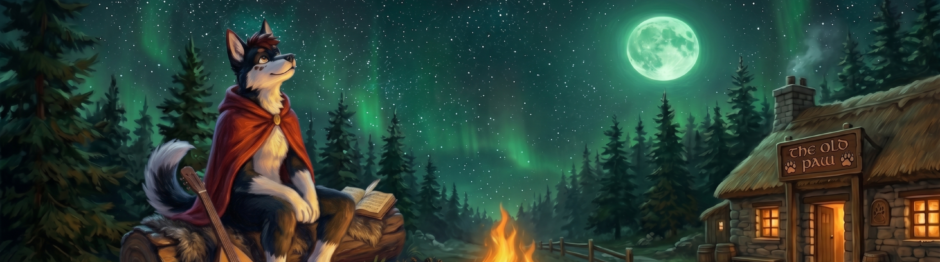
 Worthy travelers—have you come this far just to find out what happened after the forest lake? Well, who am I to deny such a desire to learn more of this tale?
Take a mug of hot tea or meat and sit down; stay a while and listen… There is so much to tell, and my fire at night is warm and friendly…
So, the forest lake and what followed—is that what you want to hear about? Very well; it was… peculiar. Instructive? However, it was certainly many things. And honestly, who would think to respond to the warning—”You realize you won’t like it once I take hold of the guiding ring”—by simply assuming there must be a reason for it? In hindsight, there was a reason, but I won’t get ahead of myself; it’s too early for that.
And yes, for you, dear German-speaking friend: there is a second fire for you
But please, worthy traveler, do not forget to return, why? Because, I tuned my lute for you this night:
You see, back then, I understood nothing of the silence of the misty forest. When you are young and wander through a misty wood with a lute, you tend to believe the world consists only of rhymes, grand gestures, and the noise you make yourself. You imagine that every silence is an abyss that must be hastily filled with words.
That evening, after the forest lake, I managed to remain silent.
The sun sank behind the mountain ridge, and the last light burned deep red in the crowns of the ancient pines before the cold set in. We walked side by side through the moss. Not a step ahead, not a step behind. It would be a lie—or an understatement—to claim I didn’t feel the leather against my throat. It was heavy, in a strange sort of way.
Back then, people in the tavern thought it was a shackle—fools even wasted mocking notes on it, complete with little bells and ribbons…
But to me, it was no yoke. It was the first thing in my life that—well, it’s hard to explain—held me. I mean, whenever my mind started racing off in a thousand directions, the cool leather against my neck reminded me of where my paws touched the ground. It compelled me to look differently—not at the clouds, but at the very next step. I know it sounds odd when put into words, but that’s how it was for me: I could feel the promise I’d made to her with every step, with every breath. And honestly, it helped.
She walked beside me, silent, her ears catching the wind. A wolf of the old laws. She didn’t understand my songs, nor did she understand why I had voluntarily put on that collar. To her, it was simply a tool. If it kept her bard from tripping over every root, it served its purpose.
A hunter like her wastes no thought on things that work.
Anyway, when we finally reached my hut, the fog was already hanging heavy around the threshold. I pushed open the heavy oak door and stepped aside. No bowing, no bard-like flourishes, no pleading. I simply made way for her. And she walked through.
I had been truly annoyed back then when she put Germonde in his place and sent me—the master of the house and the hearth—off to brew tea. But then again, you weren’t there to see it. This time, however, things were different. My life was already in her paws, yet even by the forest lake, I hadn’t fully grasped the true significance of that collar—and here, that became apparent:
I wanted to invite her to claim the rights of a guest in my home. And her? She didn’t enter like a guest asking for admission; instead, she strode past me as if returning to her own territory. And I felt an icy chill trailing in the wake of her steps. The room was damp in the semi-darkness. And there, on the rough tabletop, they still stood: two cups, untouched since early morning. The scrap of paper with the scrawled warning and the simple “V.” was gone, but the cups were full of cold, black tea.
The silent remnants of that morning when I had woken up, found her missing, and—in a fit of panic—set half the world ablaze.
She stood before them. She didn’t sniff; she didn’t touch a thing. She simply looked down at the stale tea with a gaze that held neither pity nor reproach—only the bare fact.
“The water from this morning is no good anymore,” she said, her voice as dry as snapping brushwood. “It has absorbed the bitterness of the entire day.”
I closed the door behind us, barred it against the night, and reached for the iron kettle. For the first time in days, there were no rhymes in my head, no excuses, and no fear of what was to come.
“Then I’ll pour it out,” I told her.
And I lit the stove to make her fresh tea.
That was the moment, you know? Right then, I understood… absolutely nothing. Even though everything was as plain as day—the way she sat there at her table in my house.
But it’s good that you were here to hear this story.