Travelers, be welcome, stay a while, and listen …
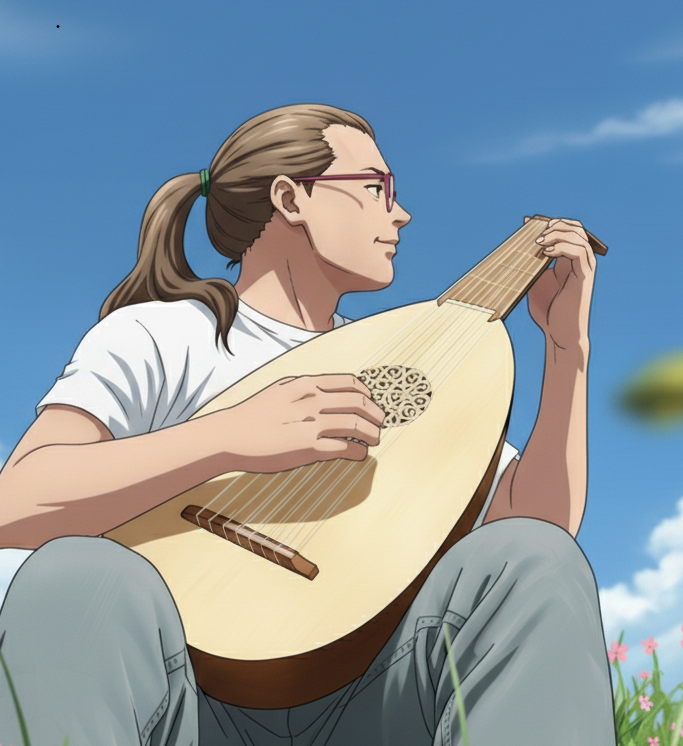
Do you have any idea how happy it makes me to welcome you back here by my fire? After all, it isn’t exactly common for someone to take so much time—endless time—in these fast-paced days. But you are here, spending time with me, I will tell you a secret about the Lore of the Mistwood Forest:
You know, after the “Heartstone” with its 415 Hertz, I have to make a little confession – why is it that “only” Fian can create this “Heartstone” thanks to his special lute tuning? The reason is much more mundane than you might think:
You have to put this mystical aspect aside for a moment and look at this rather sober “music blog” with which I’m also kind of accomp anying this whole lore. There are actually two stories, and one of them really happened like this:
Let me give you some words for the background…
Wait a minute .. where have you mentioned ‘415 hertz’ before?
Yip, traveler, on my German page – maybe I add it, maybe not. But what you are looking for can be found right here: schattenmaerchen.de
I previously owned other musical instruments from the “medieval scene,” from bouzouki to strange instrument calles “Geierleier”, from bandurria to dulcimer, from… guitar to… oh, the list is truly endless, and even now I still have an enormous collection of instruments that I enjoy picking up and playing:
But all instruments always had commonalities,
– steel strings
– high string tension
– modern swivels
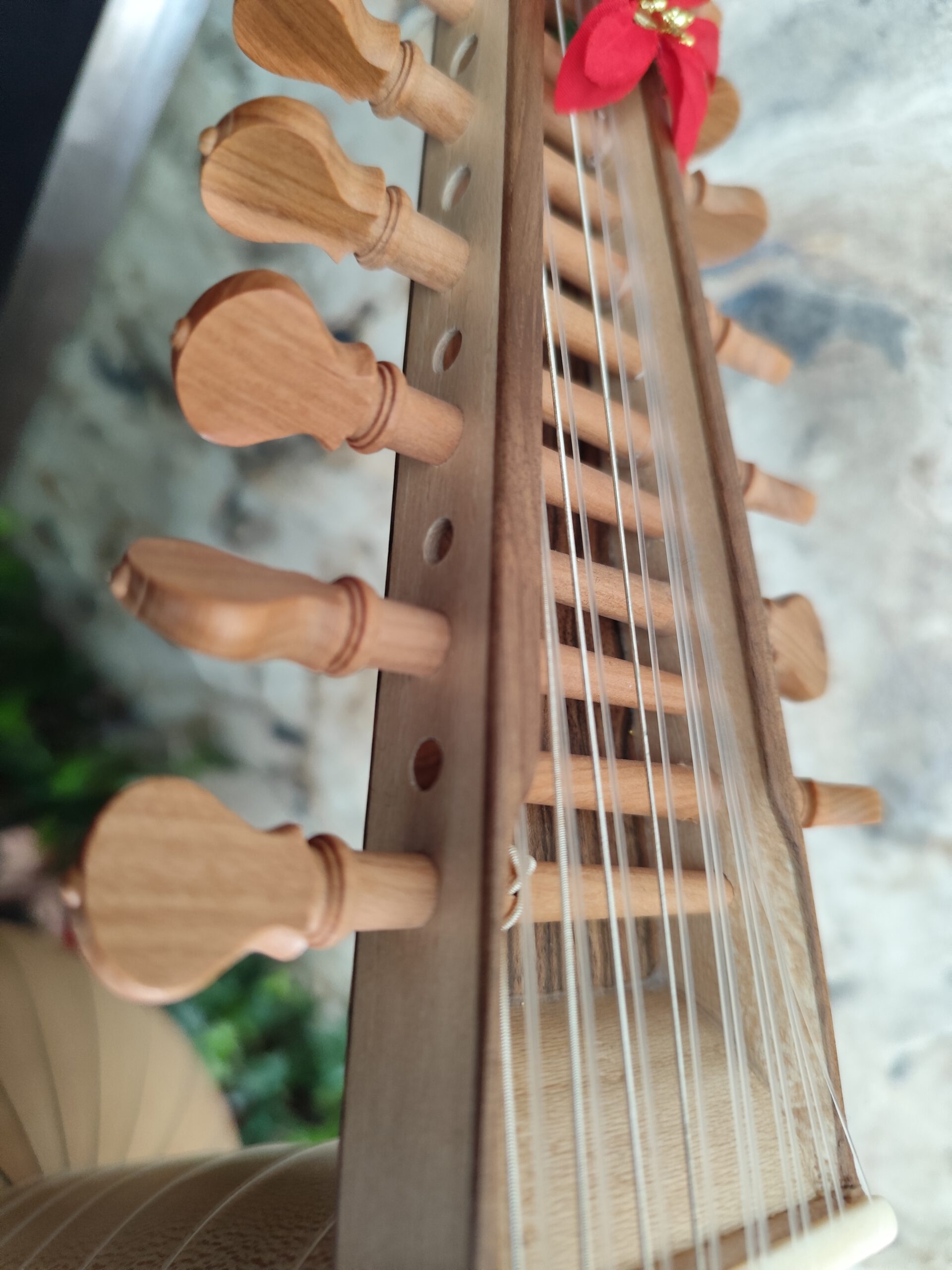 The lute was different, quite the opposite; it needs air to breathe, space to explore, and a player who doesn’t simply impose his will on it. Yes, you can do that, and no, then it will only dutifully perform its duty, but the special thing is precisely that a lute makes subtle mistakes in its sound, and it is precisely the interplay with the resulting disharmony that evokes this silvery sound. That really drove me to despair in the beginning.
And this is precisely where the real truth about the heartstone, and why a lute in particular:
As the story goes, …
Fian, during his solitary wanderings through the endless forests, found a dying bard with an old willow lute. It was a magnificent instrument, and its age made it truly special. The bard had once taken it into his care in a similar way, so that its song would never fade away. Fian sincerely promised the dying old bard that he would watch over the lute, that no harm would befall it, and that it would continue to sing its songs long after the old bard had passed away. When the old bard heard this, a tear of joy escaped his weary eyes, and he departed this world. Fian—clueless of anything—now held these lute in his paws and was determined to fulfill a promise made in the face of death. And he (just like me) initially cranked the windlasses aimlessly and without a plan, with very, well, let’s call it dubious results in the art of performance.
And in doing so, he came across a string tuning:
The lute was so thoroughly detuned that, seemingly out of nowhere, it produced total harmony when he touched the strings to do whatever.
with absolute ignorance but honest and sincere curiosity, he sought harmonies in a place where there was actually nothing to look for.
This, by the way, also explains the song “Child of the Moon,” why no other bard can ever accomplish the feat of tuning those strings. Well, of course not, if you tune an instrument so terribly and then, with feeling and patience, find a way to play the lute, no wonder…
For Fian, several coincidences occurred simultaneously:
The resonating chamber of this old willow lute, passed down by chance from a dying bard, went to someone seeking a place in a world that was otherwise hostile. This person sincerely accepted the lute, bound by his promise to himself, which opened a path for him, and tinkered and cranked the tuning pegs. In one of his experiments, he created the first nascent Heartstone, while two people sitting by the fire with him were discussing something very bloody and inglorious as he played his songs. For an uninvolved bystander on the other side of the fire, a surreal scene unfolded:
The whole thing seemed like a love story, which became known among the wolves as the “Miracle of the Moon Child.” You could see it that way; Fian, as a half-fox/half-wolf, was conceived through the direct influence of the moon, which didn’t make the whole thing implausible. In any case, Fian then began to explore the phenomenon until he found the right tuning.
The reason why no other bard besides him can do this is actually self-explanatory:
Simply put, nobody thought of doing such nonsense. Theoretically, anyone could do it; it doesn’t even have to be this particular lute, as long as it’s tuned “correctly.” And that’s the problem… This particular tuning only works with this old lute, and anyone who learned to play normally won’t be able to handle it.
Fian was only able to do it because he had nothing else to do and had dedicated himself to it. Consequently, the Moon eventually rewarded him for his boundless efforts by summoning a Heartstone with this “special lute setup”.
The exciting question: How does one come up with such “heartstone nonsense” that then gains meaning within the lore?
That in turn is actually – oh, now I’m getting sentimental – let’s agree on more years than I want to go into detail about… Okay, so this happened at a medieval market in 2010 or 2011:
Two live-action role-players sat around our medieval campfire, oblivious to their own characters. Good for them, but one of them was telling the other how the obligatory orc gangs were marauding through his homeland, raiding his village, and, in astonishingly vivid language, he was regaling us with his version of a horror/dark fantasy backstory explaining why he is the way he is. In short, the guy was really getting on my nerves with his highly passive-aggressive character design.
Back then, I was sitting by the fire with a bandurria (a Spanish version of a lute) which, funnily enough, like Fian, I had completely mistreated beforehand out of ignorance, trying to tune it to an Irish diatonic pitch. It took weeks until it finally worked and sounded surprisingly good. But what impressed me most afterwards was this bright, resonant, and clear sound that could literally sweep you while talking.
Well, anyway, I then started to methodically undermine his horror story with the bright silver sound.
It wasn’t difficult at all; I simply forced him to play along to my rhythm in the background with my silent accompaniment, and he didn’t notice the spoken-word style he started as a result. Afterwards, all I had to do was gently strum the strings to completely sabotage the nature of his statements.
And it happened as it had to:
On the other side of the camp fire, there sat someone who had watched the whole scene unfold, curiously observing how the dominant sound of the bandurria first hijacked the spoken voice and then seamlessly overlaid it. So it wasn’t really possible to understand what he was saying anymore. What finally did reach the other side was the exciting part: a charmingly murmuring love story unfolded, revolving around glory, betrayal, honor, and all manner of other things, against the backdrop of an epic battle scene. At some point, he stood up, came over, and whispered the following to me:
He had never experienced such an incredible bardic performance before. He tipped his hat to me; that was true bardic artistry. Not because I was the best, or the loudest, but because I created a space in the silence between the notes.
Never forget, my friends:
Music and sounds are sometimes something very special when they are hidden and in silence itself.
And yes, that was the origin of the “original heartstone,” and I’ve never managed to recreate it with that level of perfection. But that doesn’t matter, because I experienced it, and that’s something truly special.
With that said, farewell, my friends, but not without a little spoiler:
 She, the white wolf, never intended to walk into the Heartstone, and Fian hadn’t summoned one intentionally to stop her. But the decisions that were subsequently made change the character. Reread the story of the forest’s truth with this background knowledge, and don’t forget to listen carefully to the song, because there’s something hidden there that isn’t written down—it’s about choices and their consequences. This leads to insights that suddenly place the subsequent events in a completely different context, but I don’t want to give anything away. Have fun searching!
See you soon, dear travelers…
Yours, Gunnar